Choosing wall panels involves more than picking a colour. A customer may be thinking about the room, the finish, the dimensions or the accessories needed to complete the installation. An ecommerce website needs to make those different decisions manageable.
Our website work for The Panel Centre brings together a broad product range with several ways to browse it. The project is a useful example of how catalogue structure and practical buying information contribute to the design of an online shop.
The principle scales down well. Even a small product range benefits from being organised around the questions customers bring to it.
Give customers more than one sensible starting point
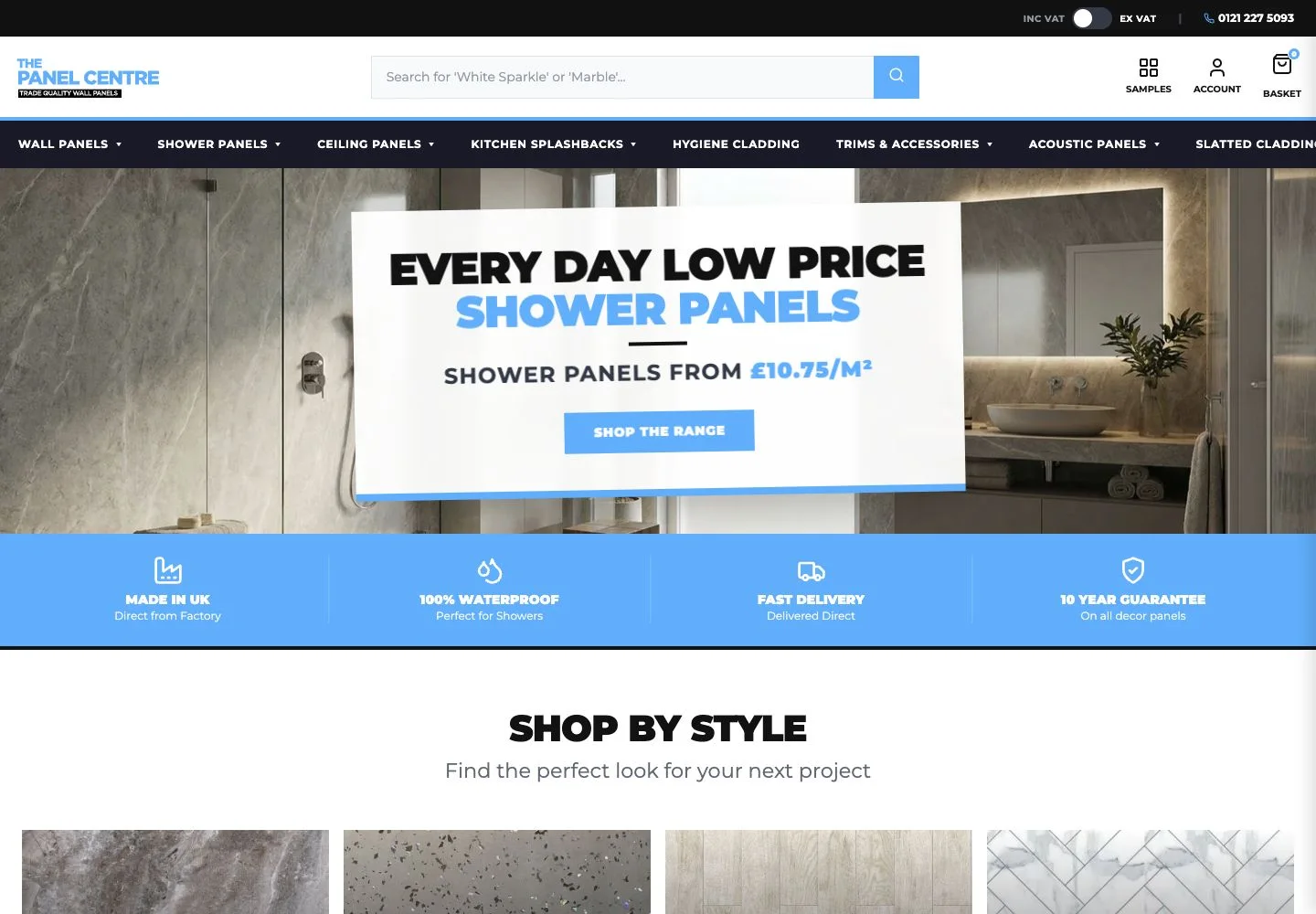
The Panel Centre offers routes through its range by style, colour, size and room. A visitor with a finished bathroom in mind can begin differently from someone who already knows the board dimensions they need.
That is a useful distinction when planning a catalogue. Customers do not all arrive with the same knowledge. Some are exploring possibilities; others are ready to locate a particular specification.
For your own shop, list the ways people describe products when they contact you. Do they name a material, a use, a problem or an occasion? Those conversations can help you choose useful category names. Keep the labels understandable and ensure each route leads to a relevant selection, rather than leaving the customer to start again.
Support the decision before the purchase
The site includes a sample-ordering route, a panel calculator and an advice section. These sit alongside the product collections and shopping functions.
They reflect different kinds of uncertainty. A photograph may help someone shortlist a finish, but a sample gives them something to compare in their own room. A calculator addresses quantities. An explanation can answer a question that a product image cannot.
When planning an ecommerce website, ask what usually holds up a purchase. The useful addition may be a sizing guide, a comparison, a sample or a clear answer about suitability. Choose the smallest piece of help that addresses the actual question. A tool only earns its place if customers can understand its inputs and use its output sensibly.
Keep the complete job in view
The Panel Centre’s navigation includes trims, sealants, adhesives and installation kits alongside panels. That gives supporting products a clear place within the range.
For a business selling materials, the customer is often trying to finish a job. Their shopping list may extend beyond the item that first attracted them to the website.
Use that perspective when reviewing your product pages. Explain which related items may be relevant and where compatibility needs checking. Avoid making customers guess whether a fitting or accessory belongs with the product they have selected. Useful cross-links should provide context, so the customer can understand the relationship before adding anything to their basket.
Make commercial details easy to compare
The website presents product dimensions and pack information, and provides an inclusive or exclusive VAT display choice. These details matter when customers are comparing options or planning a project budget.
The broader lesson is to be precise about what a displayed price buys. Make units, quantities, variations and delivery information understandable before someone reaches checkout. For a smaller catalogue, a consistent product template is often a good place to start: it makes missing information easier to spot and future additions easier to manage.
See our Panel Centre project overview for the portfolio view. If you are planning a shop or improving a product-led business website, our website design service starts with the decisions your customers need to make and the information that helps them make them.